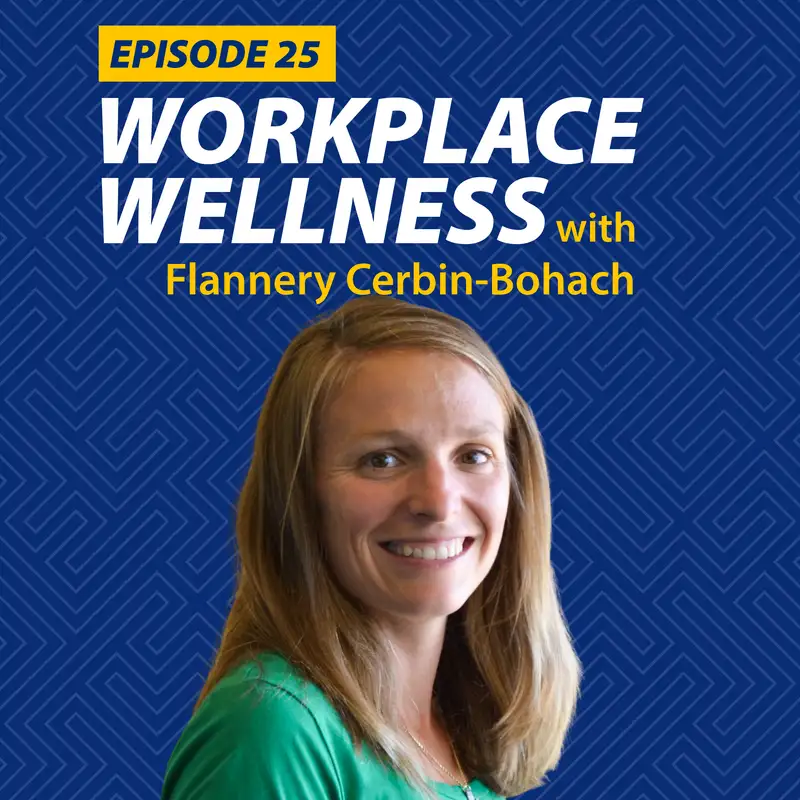
Welcome to The Catalyst, an exciting and insightful podcast produced by Northeast Iowa Community College. I'm your host, Lasack. Together, we'll explore the people, programs, and partnerships that make Northeast Iowa Community College unique. From student success stories to behind the scenes info about athletics, innovation and industry collaboration, each episode dives deeper into your community's college. Get ready for an inside look at the impact of community driven education at NICC.
Amy Lasack:Well, welcome to another episode of The Catalyst. I'm Amy Lasack, and today I'm super excited to welcome Flannery CerbinBohach. Did I get that right?
Flannery Cerbin-Bohach:You did. Good job.
Amy Lasack:Awesome. Well, today we're going to be talking about wellness in the workplace. And as we all know, wellness isn't something that we always think about in the workplace, but it really should be something we're always thinking about how people feel, where they are in life, what they're juggling outside of work, that all shows up in the workplace. And at NICC, we've been more intentional about putting wellness and life stage support front and center. And that is Flannery's actual job title, Wellness and Life Stage Program Manager, to talk about why that matters and what that actually looks like here at NICC and what it should look like in workplaces.
Amy Lasack:So Flannery, I'm really glad you're here. I wanna start with a very basic question for you is, how do you define wellness in the workplace?
Flannery Cerbin-Bohach:Yeah. Thanks, Amy. I'm really excited to be on this podcast. And I would say that wellness is truly an active process, and that's why which we're becoming more aware of and making choices that lead us to a more successful existence. So here at NICC, we focus on the whole person and knowing that our well-being is really wrapped up into lots of dimensions.
Flannery Cerbin-Bohach:So those are our physical aspect, emotional, social, intellectual, spiritual, environmental, occupational, and financial. So we actually have over 400 full time and part time employees here at the college, and they span life stages that are early adulthood, which we're establishing our careers. We have middle adulthood, which we're maintaining that career, and then late adulthood, which is usually that transition time thinking about retirement. And we span all of that. We have our youngest employee is 17 and our oldest is 83.
Flannery Cerbin-Bohach:We really have
Amy Lasack:to meet people they're at. Did not know that 17 to 83. That's amazing.
Flannery Cerbin-Bohach:Yeah, it's a really wide range. Everybody's on that journey. You know, think about yourself at 17 and where you were and what mattered to you. Then imagine your future self at 83, you know, and it's going to look really different.
Amy Lasack:Completely different, yeah. So what got you interested in this type of career choice and focusing on the things that you focus on in your current position?
Flannery Cerbin-Bohach:Yeah, I mean, my educational background is in actually environmental studies and in public health. So I have an undergrad in environmental studies. I took a break for a while, worked for a series of nonprofits that focused on access to local food and physical activity, primarily in K-twelve settings. And then I really was just interested in that intersection between environmental health and human health, and that drove me to go back to school for my master's in public health.
Amy Lasack:Very cool. Yeah, thank you. So I know since 2020, there seemed to be a massive shift, right, in workforce wellness and kind of the attention that it received. What do attribute that to? What kind of changes have you seen in the last five, six years?
Flannery Cerbin-Bohach:Yeah. You know, 2020 was this turning point for a lot of us, and, you know, it's pre pandemic, post pandemic. And I would say that, I mean, the pandemic was a different experience for everybody. People it ranged from people losing loved ones, getting really sick, having new stressors in their lives, to people who maybe thrived during the pandemic. So I I don't wanna, like, just say there was one size fits all in that experience, but we saw generally that the pandemic definitely increased caregiver demands and intensified stress for people.
Flannery Cerbin-Bohach:It led to social isolation and just the uncertainty around jobs in general. And I would say that people are kind of still coming out of that. And so a wellness program is here, I guess, to support employees in the workplace. But also, we have seen a big shift as well to remote work and hybrid remote work, and that was NICC included. So a lot of us were sort of thrust into that environment without necessarily being prepared for it.
Flannery Cerbin-Bohach:So I think about the stories that I've heard about K-twelve teachers who had to all of a sudden scramble to get their entire courses online. Imagine elementary teachers preparing online learning for kids that are in their grade. Thankfully, here at NACC, we were really well equipped in that realm. But we closed our forward facing doors. We were still online, but everyone had to switch to remote learning and working for a while, and I had a lot of people reaching out and seeking support because they had these new routines.
Flannery Cerbin-Bohach:How do they set boundaries between my personal life and my home, my work life, when the couch is the new office space? And so now we've come out of that, and a lot of people would say that remote work or hybrid remote work has intensified or helped people's work life balance. Gallup cites that, that seventy six percent of full time hybrid workers in The US cite that improved work balance from the hybrid remote work situation. But we need to acknowledge that it does make it harder for employees to turn off. Yeah.
Flannery Cerbin-Bohach:Than just checking your email constantly throughout the day, designate some times, one, two, three times a day where you're gonna just focus on emails. Then, especially at home, focus on keeping technology out of certain areas. So no phones, no laptops in the bedroom, and have those shutdown times. And I would say that remote work, hybrid work does lay the foundation for social isolation. So you just have to be more intentional.
Flannery Cerbin-Bohach:You're not going to run into somebody in the hallway or the restroom and have that side conversation, asking about their family or whatever that we are so used to in an actual workplace.
Amy Lasack:Yeah, absolutely. And I think, too, about just the changes I've gone through in my workforce career, where you used to be able to just as soon as you walked out the door, you can shut things off because no one could get ahold of you. Right? But now with cell phones and email and texting, is really hard to create those spaces so that you're not connected 20 fourseven.
Flannery Cerbin-Bohach:Oh, absolutely. Yeah. And I was just listening actually to the podcast that you did on the AI. I had a guest on from AI. It was one of your guests was talking about, yeah, believe it or not, you know, it wasn't that long ago that we didn't have computers that we would take home.
Flannery Cerbin-Bohach:So, yes, the I mean, the work the work world is always constantly changing. We see that with technology. But but, again, we just need to focus on ourselves and know that, like, we do sit for upwards of eleven, twelve hours a day, and we do have screen time, and that does lead to digital fatigue that if we ignore those things, the years compound on it themselves. And we don't want to wake up with splitting headaches and migraines and all of that from just years of not taking care of ourselves.
Amy Lasack:Yeah, absolutely. I think one of the things you just said was so important is intentionality, whether it's being intentional about when you check your email or being intentional on having that human connection. Oh, absolutely. And being able to schedule that or make sure that it's a part of your day, it can become really easy to sit behind a door and work on your computer for eight hours.
Flannery Cerbin-Bohach:Oh, for sure. Or hide behind a screen.
Amy Lasack:Hide behind a screen. Yeah, absolutely. So at NICC, one of the pieces of our strategic plan talks about revitalizing our culture and focusing on the well-being. How does that translate to what you're seeing here at NICC?
Flannery Cerbin-Bohach:Yeah, I was really thrilled to see the new strategic plan and that whole process was really inclusive and had a lot of chances for employees to weigh in and community members to weigh in. And I was really thrilled to see that wellness themes emerged in that plan. I think revitalize our culture, specifically grow employee engagement through enhanced connection, professional development, and a culture of connection. And I think that really that is the strongest pull for a wellness program is that it really truly is speaking to our social and our intellectual well-being. So, you know, as full time employees, we spend roughly two thousand hours a year at work, and that's going to be a lot of interaction with our colleagues.
Flannery Cerbin-Bohach:You know, we're gonna be potentially spending more times with our coworkers and our family during any given week. And so we think about the importance of having those healthy relationships at work that are gonna boost your morale and help kinda combat burnout and ultimately increase your productivity. And I would say here, we we've done a really good job of fostering that sense of connectedness. So we have, you know, examples of, like, our faculty networking hour, the upcoming Bring a Mug event. We have HR focus groups and q and a with leadership.
Flannery Cerbin-Bohach:All of that, from my perspective, is really helping build a layer of trust and connection and ultimately helping build relationships, which is important for our social well-being. And then I would say, like professional development falls into the camp of enhancing our intellectual well-being and just being active lifelong learners, trying to think creatively, critically and sort of trying to help foster that sense of creativity or curiosity in people. And it's great. Like, if that can happen at work, perfect. People don't have to find it, you know, outside of work.
Amy Lasack:Yeah, so important. And one of the things that I think about are the role of a supervisor or a manager in making sure that this type of activity is important and shows up within the DNA of the culture. How do you see the role of a leader or supervisor playing in supporting these types of things?
Flannery Cerbin-Bohach:Yeah, I mean, think it's really important. I mean, know, a supervisor and a supervisee, that's a relationship. And like any relationship, you need healthy communication and a sense of trust. I think also I think also we sometimes push too much on our leadership, and we expect them to, you know, solve all the world's problems and be everything to everybody. But I think I think there's a lot of, like, personal responsibility for employees and how they show up and how their attitude can impact those around them.
Flannery Cerbin-Bohach:And on alternatively, they a culture can come from bottom up. It doesn't have to come from top down. Mhmm. So I think it's sort of this it's a it's a two way relationship for sure, but I think sometimes we're kinda easy to brush off that, oh, everything has to come from leadership. But I do think we'd obviously need support and permission, and the expectation should be, yeah, take take a mental health day if you need it.
Flannery Cerbin-Bohach:Take your sick time. Take your vacation time. You know, we I want you at work being productive and contributing, But I know that by you taking care of yourself, you're gonna show up much better.
Amy Lasack:Yeah. That's a that's a really good point on everything. The relationship goes different directions and having that supportive nature can really go a long way. And wellness and productivity efficiency really is it's interchangeable. I mean, it's it's connected so much.
Amy Lasack:Can you talk a little bit about that?
Flannery Cerbin-Bohach:Yeah, I mean, I think it's it's maybe sort of something that we we don't often stop and think about. But, I mean, it it's kinda common sense. I mean, think about, you know, the times that you have been outside walking walking, taking in observations of your natural world or being out in the sunshine or even being on vacation? Where does that leave you? How do you feel?
Flannery Cerbin-Bohach:And obviously, those are things that you're doing for yourself. You're maybe being more present in a space. And then the expectation is if you go back and you or you're asked to refocus after something like that, your head is gonna be much clearer. We know that physical activity improves cognition and reduces stress. Why would we not encourage people to take that walking break at lunch, to go get their blood flowing, to recharge?
Flannery Cerbin-Bohach:I mean, the win win here is bring a coworker and have a conversation, you know, that's work related. And, you know, you're you're moving, you're you're taking in some fresh air, and you're maybe even being productive in in the work world. So I think definitely, productivity is enhanced when the person is taking care of themselves.
Amy Lasack:Yeah, absolutely. I think even the little things, right? I mean, definitely use your vacation time that that is to help keep you balanced. But I know for my work day, I think it's called the Pomodoro effect, I use my phone and set an alarm for a certain amount of time. And it reminds me I need to get up, need to walk around, talk to somebody because and I find myself much more efficient when I come back to the computer afterwards than if I'm gonna sit there for two hours straight and work on something.
Flannery Cerbin-Bohach:Right. Absolutely. I mean, and, you know, you can find yourself in a in a good flow state for a while. And sometimes it's like, if you're working on a good project and you lose track of time, great. Like, you know, that's a good thing.
Flannery Cerbin-Bohach:It's just, you know, you do if you need a reminder to get up and move, like, just set it. I'm do it. I I was just talking with somebody this week about that, and she's involved in the wellness challenge here and had selected an bonus challenge of, like, getting up every hour and moving a little bit. And she's like, oh, it's so hard. Like, you know, because it wasn't in her you know, she wasn't aware of it, but she was just kind of hunched over and sitting all day.
Flannery Cerbin-Bohach:So I had never heard though of that app, so I'll have to look it up.
Amy Lasack:Yeah. I love it. And it depends on what I'm working on, but I might set it for thirty minutes and then go walk around for five or set it for sixty minutes and then go walk for fifteen. But it just, again, going back to the intentionality, I know it's important. I know I'm more efficient.
Amy Lasack:So that works out well for me. So what are a couple of things? You mentioned some things that NICC is already doing as far as like the wellness challenges, but can you talk a little bit more about those? And then what are some other things NICC does to make sure that wellness stays in the forefront?
Flannery Cerbin-Bohach:Yeah. The wellness challenge is activity based, and so that occurs four times a year. And really, the idea here is that you're you're opting to be on a team with your with your coworkers, and it's all movement based challenge. So you record your your weekly activity minutes, and and there's camaraderie in that. So, you know, you have you have these teams that there's a leader in that team, and maybe they're sharing tips or trying to get people inspired or encouraged.
Flannery Cerbin-Bohach:You know, when it's negative 20 outside, how are we gonna move today? And then over the years, it's kind of layered on or tweaked the challenge so that it includes other aspects. So we might focus on some nutrition aspect or some emotional health aspects or mental health aspects of the challenge just to kind of keep it fun. Folks can win prizes, but, you know, I think most people would say they do it just, you know, for the accountability of having people to to say, hey. You gotta get out today and move.
Flannery Cerbin-Bohach:And so those challenges have we we see anywhere from, like, 60 to 80 people participating in those a quarter. And and they're fun for me because I just I create the shell, and I I watch it. I watch people. I was run with it, literally. And so that's one one thing that we do, and I would say that's primarily like focusing on physical well-being.
Flannery Cerbin-Bohach:But we also offer on campus flu shot and biometric screenings. And this actually has taken place for years. But the idea is just the convenience of getting blood work at the college. It all remains confidential. You know, I don't see the results between you and the provider, but it's just the fact that you can go and work and get your cholesterol, your glucose, your thyroid levels, all that screened and get that flu shot and then bring those to your doctor.
Flannery Cerbin-Bohach:Any employee can participate in that for no cost and spouses on the insurance can participate that for no cost and then spouses who aren't can participate for a pretty low fee.
Amy Lasack:I love all of those things because it's, I know for me, it can all of a sudden be March and I'm like, I never got my flu shot. No wonder I'm You sick now, just don't make it a priority or getting my blood screens. And so for NICC to make it a priority and take that mental load off of somebody that you don't worry about calling to schedule it, we've got it here for you. That really does impact and make a big difference for stress levels for people.
Flannery Cerbin-Bohach:Yeah, mean, it's definitely a nice perk, I would say for sure. And we see, I mean, retirees participate too, and it's so sweet. They come and it's social hour and they're drinking coffee and eating pastries afterwards. And I have to chuckle because it's like, oh, know, sorry that we just had to put you through a blood draw for this. Yeah.
Flannery Cerbin-Bohach:So that's that's one thing. Then sort of the other, I would say, program that's attached to that is our we have a wellness incentive. So that is attached to our insurance. So if you're on the college insurance, you can earn a $150 credit into your HSA or FSA. HSA being health savings account and FSA being a flex spending account.
Flannery Cerbin-Bohach:But the idea is, like, you're focusing on a few health behaviors. You you do those things. You go to the blood screening, or you go to your annual preventative exam with a doctor and a dentist, and then have a fitness routine that you can document using our college EAP or employee assistance program in some capacity. If you achieve all of those, you can apply for a credit. And it's a nice it's just a nice seed money.
Flannery Cerbin-Bohach:I know $150 this day and age maybe doesn't get you too far, but it's something, and it can incentivize those good behaviors.
Amy Lasack:That's fantastic. So I know we'll probably have a few folks from other companies listening. If you had to give them advice, let's say they aren't really doing much wellness wise within their company, What would be something easy that they could take a look at implementing as a quick turnaround?
Flannery Cerbin-Bohach:Sure. Yeah. I think that it's it's really just about starting and starting somewhere, and it can be really small. But, you know, ask your people, like, go to your people and say, what do you want? You know, that's people support what they help create.
Flannery Cerbin-Bohach:And so if a person is feeling like they were included in that process from the very beginning, I think it's going to be embedded and more much more sustainable in the long run. So when I came to the college in 2015, this position was actually brand new. And I and my first instinct was to form a committee, a wellness committee, and, and they really have become the ears and eyes and the champions of the wellness program for me, and a sounding board. So I know this can happen at your business, grab some coworkers that you know, maybe are having, you know, a a special interest in in something wellness related, and it can be the programmatic stuff is is the simple, easy stuff. Mhmm.
Flannery Cerbin-Bohach:It can be fun. You know, it can be we're just gonna pause and have lunch together, you know, two days a week and or, hey. You know, let's do a a reset on our potlucks, and we need to instead of bringing all these treats, like, let's focus on bringing each bringing a healthy recipe. Or maybe it's getting a walking group together that if it can't be during the day, maybe twenty minutes before the day finishes or set a goal of doing a company half marathon. Who wants to train for a half marathon with me?
Flannery Cerbin-Bohach:So those are all things that are really kind of low hanging fruit that are going to be big wins. And then in the long run, you know, you can think about just what kind of culture do you want to shift to or create, and that'll be your team that can help you kind of envision that or make that a reality.
Amy Lasack:Yeah. Great advice. Get the get the feedback from your team. And a lot of the things you just talked about, you don't need a huge budget, if a budget at all. It's just the permission and the structure to enable people to be able to do those things.
Flannery Cerbin-Bohach:Yeah. Absolutely. I think it is kind of a a misnomer that you do have to have this grandiose budget, and it and it really doesn't it doesn't have to be be that. I mean, certainly, some seed money helps, but a lot of this can just be done, you know, being in you know, choosing choosing ideas or projects that, you know, jive with people.
Amy Lasack:That's great. Well, I know you've mentioned you've listened to a couple episodes of the podcast before. So you're probably familiar that with a lot of our podcasts, have this fact or fiction piece of it. So if you're game, we've got a couple of fact or fiction statements for you.
Flannery Cerbin-Bohach:Sure.
Amy Lasack:Okay. So the first one is prioritizing mental health in the workplace directly improves attendance. Is that fact or fiction? Fact. Fact.
Amy Lasack:Yeah, probably makes a really big difference. If people feel like their mental health is supported.
Flannery Cerbin-Bohach:Oh, absolutely. Yeah, we're seeing that more and more that it's sort of becoming an expectation that employees that have when they come to a business is how are they going to support me, my mental health?
Amy Lasack:Great. We kind of addressed this. So if people are listening, they should be able to answer this. But wellness programs are only for large corporations with massive budgets.
Flannery Cerbin-Bohach:Fiction.
Amy Lasack:Yes. Lots of things you can do on the lower end if if needing money at all. What about you can't effectively measure the success of a wellness program? Is that fact or fiction? Fiction.
Amy Lasack:So tell me a little more about that. What sort of things can you look at?
Flannery Cerbin-Bohach:I would say, you know, I guess, like, big picture, like, employee turnover. You know? I you know, none of it's a little bit hard to draw correlations here, but I would say definitely that I would say there's some data that you can pull as an aggregate within, like, the health insurance model, you know, data that we have, you know, and, like, pharmaceutical usage, for example. Sure. And then also just, like, surveys about how employee surveys that you can put out.
Amy Lasack:That's great. Alright. So another one if people were listening. How about a workplace culture of wellness starts with leadership?
Flannery Cerbin-Bohach:I put both fact and fiction.
Amy Lasack:Fact and fiction.
Flannery Cerbin-Bohach:Because yes. So for me, I got hung up on that because I do think it's a both and. But leadership definitely can set the tone.
Amy Lasack:Yes, absolutely. How about workplace wellness is just an HR trend and it will fade away?
Flannery Cerbin-Bohach:Oh, fiction.
Amy Lasack:Yeah, I think you're right. I think the whole being and looking at the whole person at work is very important and everybody should be taking a look at. I don't see that going away. And then the last one, employees who feel healthy and supported are more likely to stay with a company long term. Fact.
Amy Lasack:Absolutely. Such a big deal. So for individuals that are listening, whether they're NICC employees or individuals in the community, if they had to take one thing away from this conversation, what would you hope it would be?
Flannery Cerbin-Bohach:I think as an individual, just think about how you show up and remember that, you know, you have a sphere of influence, and so that might be the people around you that you know, your coworkers. It could be broader than that. It could be in a department. It could be an entire institution or business. And think about that sphere, how you're channeling energy into that sphere.
Flannery Cerbin-Bohach:And if you're not channeling good energy, you know, take a look in the mirror and ask yourself, you know, what do I need as a person? Do I need to move more? Do I need emotional support, mental health health help? And and do those things for yourself because, ultimately, you do have you do have an impact on other people and even just the way you carry yourself in the world. You know, it it exudes an energy, and you ultimately would want it to be positive if you want your business to thrive and succeed.
Amy Lasack:I love that because it really just says you have control over your attitude and how you bring things, and sometimes it's just about addressing what you need in that moment.
Flannery Cerbin-Bohach:Oh, absolutely.
Amy Lasack:I love that. Well, Flannery, thank you so much for joining us today and talking about all things wellness. Very important topic. We appreciate you joining us on the Catalyst.
Flannery Cerbin-Bohach:Thanks so much.
Amy Lasack:So if there's one takeaway for those of you that are listening, wellness at work starts with noticing how people are doing, what they need, where we need to make space for them. And also, as we just talked about noticing what you need for yourself and making sure you're providing that space for yourself. So thank you again, Flannery, for the conversation. And to our listeners, we encourage you to take one small step this week to support well-being, whether it's for yourself or someone you work with. Thank you for listening to The Catalyst.
Amy Lasack:We'll see you next time. Thanks for joining us on this episode of The Catalyst. If you enjoyed the conversation, make sure to follow or subscribe on your favorite podcast platform so you never miss an episode. Want to learn more about NICC and the many ways we support our students, partners, and community? Visit nicc.edu for more resources and upcoming opportunities.
Amy Lasack:This podcast is produced by Northeast Iowa Community College and hosted by me, Amy Lasack, with executive producer Tessa Hill, producer Travis Hunt, and graphic designer Ashley Konzen.