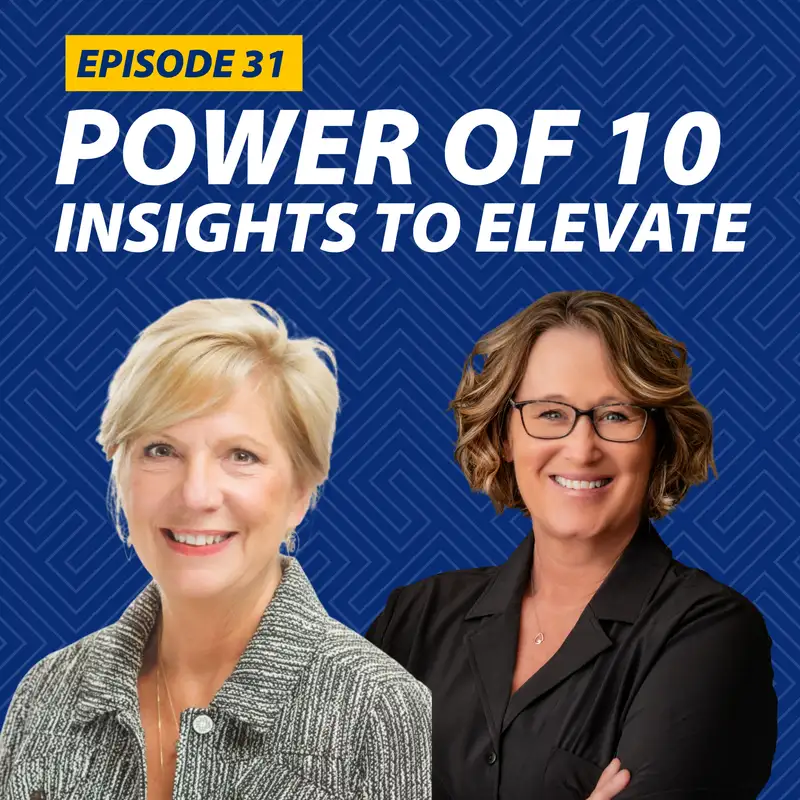
Welcome to The Catalyst, an exciting and insightful podcast produced by Northeast Iowa Community College. I'm your host, Lasack. Together, we'll explore the people, programs, and partnerships that make Northeast Iowa Community College unique. From student success stories to behind the scenes info about athletics, innovation and industry collaboration, each episode dives deeper into your community's college. Get ready for an inside look at the impact of community driven education at NICC.
Amy Lasack:Well, hello, everyone. Welcome to The Catalyst. Today's episode is all about energy, ideas, a little bit of inspiration that maybe you didn't even know you needed. We're talking about the power of ten, one of NICC's most dynamic events where 10 local leaders each take just ten minutes to share something impactful. It's one of my personal favorite events that we do.
Amy Lasack:It's fast, it's real. It's kind of event where you walk away thinking just a little bit differently than when you walked in. And today, we're going to get a preview. I'm joined by two of this year's speakers, one from our Calmer event and one from our Dubuque event. They're going to give us a little glimpse into the ideas that they're going to bring to the stage.
Amy Lasack:So I wanna welcome Rachelle Howe, the Executive Director of Upper Explorer and Land Regional Planning Commission, and Molly Grover, the President and CEO of the Dubuque Area Chamber of Commerce. Welcome.
Molly Grover:Thank you, Amy.
Rachelle Howe:Thank you for having us.
Amy Lasack:So I'm excited to talk to you both about this. This is one of my favorite events because it is fast paced and everybody comes in with just a little bit of a different angle on how they're sharing their thoughts and what they've learned over their years as they've become leaders within the community. So I'd love to start by having each of you maybe just share a little bit about the work you do here and the role that your organization plays in making an impact in your communities. And Molly, you don't mind, can we start with you?
Molly Grover:Sure. Thank you, Amy. And again, thank you for this invitation. It's an honor to be included this year, and looking forward to the event. And I'm looking forward to learning as much, from others as I am looking forward to participating.
Molly Grover:So the Dubuque Area Chamber of Commerce is an awesome organization. We're a membership organization. We have about a thousand members. We are the b to b headquarters of the Tri States, and we'd like to say that, our three c's are we're a champion for robust business climate, so we're all about promoting, the local area business climate. We're catalysts for business development, professional development, and community development.
Molly Grover:And, last but not least, we're the connectors that advance relationships that strengthen the local economy and the community. So that kind of encompasses everything we do. We have over 300, events and programs on an annual basis intended to educate, intended to impart knowledge because we believe knowledge is power, to provide leadership development, networking. We're very active, and very, visible. So that's kind of, us in a nutshell.
Amy Lasack:Yeah. 300 events. You are definitely very active and visible. That's fantastic. Rachelle, can you talk a little bit about Upper Explorer Land and your role?
Rachelle Howe:Sure. I am with Upper Explorer Land Regional Planning Commission, and I have been with the agency since 2009 and had been the executive director since 2011. Our agency was formed in the late '60s by the state, and they broke the state into regions to be an extension of city and county government for non duplicative services that we could provide to cities and counties. In 1972, we developed forming with Almaki, Clayton, Fayette, Winneshiek, and Howard Counties, We are what you call a council of government, and we carry out 70 to 90 projects at any one time. We have 14 staff right now, and we are located out of Decorah, but we're dedicated to public service, working to support our families, businesses, cities, counties.
Amy Lasack:Great. Well, thank you. And it's clear just listening to each of you for a little bit that you're really doing some impactful work. So I'm curious, when you were asked to be a part of the power of 10, what was your first reaction? Rachelle, we'll start with you.
Rachelle Howe:Yeah. I guess my leadership has been deeply shaped by the work that I've completed. When I graduated from college, was in the private sector, just very minimal for two years, and then I went right to the nonprofit work. So that public sector really gives me passion. Then you have to figure out how to provide leadership within that realm.
Rachelle Howe:It's a little different than sometimes a for profit or a business. And so working with boards and cities, elected officials is a little bit different leadership style that is needed than working in a public or in a private sector.
Amy Lasack:Great. Thank you. Molly, what about you? What was your first reaction?
Molly Grover:So I have been a chamber professional for thirty one years, and, time flies when you're having fun. One And of my mantras has always been shining the light on everybody else. So when I was asked to do this and talk about myself and leadership insights and impactful tips and lessons, I I must say it's, out of my comfort zone to talk about myself because that if you know me, I believe in giving everyone else the credit and shining a light, attention and all eyes on me, is not my thing. That being said, I love the work that we do, and it's an opportunity to talk about an industry that I love and has really changed my life and in ways that I couldn't even understand thirty years ago. I fell into this profession totally by accident, and that's, you know, part of the insights that I'll share.
Molly Grover:But it is an honor, to be included. So thank you for thinking of me.
Amy Lasack:Well, let's build on what you're just talking about, Molly, on, what you're gonna be sharing at your event. You're the speaker at the Dubuque event. Can you give us a little sneak peek on what you might be talking about without giving us too much? Because we do want people to come and listen.
Molly Grover:Sure. So I would say, the thoughts that I'll be sharing, the 10 things we had to write a paper that everyone will get. It was really insightful doing that, because it was introspective. And one what I learned from doing that and what I'm gonna share is it's as much personal as it is professional because I don't believe that those things are separate. I I believe that what you bring to the table from your background, from your, personality, from things that you value or important to you, translate in the professional world as well.
Molly Grover:So I share a lot of things that are, extremely personal, that I hadn't didn't necessarily plan on sharing. But when I started making a list of the things that I thought were most impactful, for me and my career and how I got to be where I am, it was, kind of enlightening, to realize how much of it, was steeped in, personal lessons as much as it was professional.
Amy Lasack:I love that because I think a lot of younger leaders come into the world of work thinking they have to compartmentalize who they are as a person versus who they show up at work. And from what I'm hearing, you can't really do that if you're gonna meet your full potential. It's all interwoven.
Molly Grover:Well, that's so true. One of the things and I couldn't figure out what I wanted to call it. You know, a lot of people call it being authentic. And, somebody said to me once, you're so, they said, don't take this the wrong way, but you're so un CEO like. And I said, no.
Molly Grover:That's actually the nicest thing that you could ever say to me. I want to be approachable. I want to be I I I've never understood people that, make themselves feel better by making other people feel less than. I believe on, you know, we're equals. And so one of the the, without giving too much away is be unapologetically you and, and all of you because I think that, embracing yourself well, you only know how to be yourself, but trying to be someone else, and it's exhausting.
Molly Grover:I'm trying get into a mold that someone expects a certain level or a certain way that you're supposed to act or carry yourself or, you know, don't you know who I am, kind of perspective that that's just not who I am. And I believe that it's been really important to, embrace that and lean into that, as it translates to my career and where I'm at today.
Amy Lasack:I love that. I can't wait to hear more from you. Rachelle, what about you? Can you give us a small sneak peek?
Rachelle Howe:Yeah, and like Molly said, I feel that I'm similar. Think that some of the younger folks are trying to separate themselves from their personal life and their work life, and I don't know if that can always go hand in hand, but my leadership style has definitely evolved since 2011. I like to think of myself as evolving and growing. I like to think that I'm a life learner, and I do enjoy learning, and I have no problem stating that I'm still learning as well, and even to our staff and to our board members. But I've become to understand my personality and my leadership style, and I think that's so important, is understanding what you do well and what you do not do well.
Rachelle Howe:And then asking for help, asking outside resources, building a community, a network of positive others that you can contact and can ask, How are you doing this? How am I doing? That type of thing. Having a really good sounding board and asking for the feedback, I think, is important from your board members and your staff. But leadership to me is about creating an environment where people do their best work.
Rachelle Howe:Like Molly, I like to be less of a CEO and more of an individual, more of an empathetic person to our staff, but it's less directing and being more supporting.
Amy Lasack:That's great. And I know Rachelle, I know you've been excited about coming to this and we're excited to hear about all of your insights. If somebody is sitting in that calmer audience that day, what are you hoping that they can take away from your ten minutes and maybe do differently in their lives?
Rachelle Howe:Yeah. Without giving too much away, I mean, one of them is listening. I probably in my early years was not a great listener. Maybe my parents can vouch for that, right? But, know, listening instead of speaking, I think that's really important.
Rachelle Howe:But I guess my call to action or my takeaway for the folks there is to just surround yourself with positive people, and stay open to new opportunities. Don't and don't underestimate the impacts that we all are making within our business lives and within our personal lives. I heard the term servant leader in the past, and I've listened to some of those talks, and that's where I want to be, and I think that's where
Amy Lasack:we all need to be. Great. Molly, what about you? We have a great lineup in the Dubuque area. What are you hoping from your ten minutes of that little talk that somebody will leave with?
Molly Grover:Oh my gosh. That's a great question. And I want to, what Rachelle said, hiring great people that surround yourself with people that know more than you, that are smarter than you, that that is the best thing, and then get out of their way and let them do them just like you do you. I hope that at the end of the session or my ten minutes, I hope that people feel like that the world is their oyster, that, there's all kinds of opportunity out there and you don't know what door is gonna open and you don't know, you know, when a door closes, another window opens, or maybe it's vice versa. But, there is so much, so much opportunity and, so many things that you can do and that you can accomplish and how you treat other people matters.
Molly Grover:And so be open, be kind, make good choices, and, be true to yourself, at the end of the day.
Amy Lasack:Great. Well, what were some of the inspirations that you had throughout your professional career, maybe mentors or somebody that you looked up to as a leader that helped shape who you are today? Molly, we'll start with you.
Molly Grover:I love, what, Rachelle said about asking for help. I started in this industry. I got hired for the job. I applied for it not knowing what it was. I got the job thirty one years ago, and I knew nothing.
Molly Grover:I didn't even know how to run a computer. And there was a dot matrix computer and and a a computer and a rotary dial pump, and there was no training manual, nothing. So asking for help is so, so important. So I love that Rachelle keyed into that. Mentors are really important.
Molly Grover:And so going all the way back to the beginning, reaching out to, I reached out to the executive director of the largest chamber in the county that I was working in because it was a population of about 3,500 people. And she was a veteran, and she had been doing it a long time, twenty five, thirty years. And, she was instrumental, in her support and her guidance, suggesting I get involved with associations and groups related to the industry. And then, through that, I met someone named Pat McGoy, who is a former chamber president in Coeur D'Alene, Idaho, and I met him at institute about twenty eight years ago. And, I was immediately drawn to him, his style, his charisma, how much he loved the industry, how successful that he was.
Molly Grover:And I I walked up to him and I said, I wanna be you. And, I set my goals of where I wanted to be in my career, based on what I saw through him. We've been lifelong friends. He's just retired. He was a consultant.
Molly Grover:He left the, being a chamber CEO to help chambers all across The United States. He's known as the chamber mentor, ironically, and he has been, just a game changer for me in my career.
Amy Lasack:Oh, what a fantastic story. And it just really highlights the importance of not being afraid to network and talk to people. And this is a great event for people to do that. Rachelle, what about you? What has inspired you over your professional career?
Rachelle Howe:Similar to Molly, finding those organizations, whether they're federal or statewide or even local organizations within our region that you find like folks, that they need support as well as that you need the support. And I've found that within our local area. But a big shout out for me would be there's 17 councils of government across the state, and our agency is called ICOG. And what ICOG does well is help mentor new councils of government directors when they come on board. And so, you know, Rick Hunsager in Region 12 and Mike Norris.
Rachelle Howe:I mean, I just have a group of five of them that I speak to on a weekly basis. What are you doing about this? What are you doing about that? How did you handle this? And I think having that sounding board for all of us is very effective and gives us the support that we need to be good leaders and to engaging and to keep learning.
Rachelle Howe:And I think that's important for me is that I don't have to always know all the answers, but I know where I need to go to get them.
Amy Lasack:Love that. Well, I just in the little bit of time that we've talked, I cannot wait to hear everything you all have to share in the ten minutes as well as the nine other speakers that'll be at each of the events. So as we wrap up our podcast, we have a little segment, fact or fiction. We'll read off a couple, statements, and you let us know if it's fact or fiction. We'll kind of alternate between the both of you.
Amy Lasack:So, Molly, we'll we'll start with you. How about this statement? Preparing for ten minutes is harder than giving a full one hour presentation. Is that fact or fiction? Fiction.
Amy Lasack:Great. Rachelle, how about leadership is an innate trait rather than a set of strategies that can be learned and applied? Fiction. Fiction. Definitely.
Amy Lasack:How about Molly? The way you lead today is very different than how you led early in your career.
Molly Grover:Fiction.
Amy Lasack:Fiction. Great. Rachelle, to be a truly effective leader, you must be the most extroverted person in the room. Fiction. We've got a lot of introverts out there.
Amy Lasack:Very happy that you said that. And then Molly, how about writing down your top 10 leadership insights actually changes the way you implement them in real time?
Molly Grover:Fiction.
Amy Lasack:Fiction. We had all fictions today. Great. Well, I want to thank both of you for your time. This is just a taste of what's going be coming at the Power of Ten.
Amy Lasack:And if you're anything like me, it probably makes you want to hear more. So thank you, Molly, and thank you, Rachelle, for your time. I'm super excited to hear more of what you have to say.
Molly Grover:Thank you so much, Amy. Looking forward to it. I can't wait to learn from everybody else.
Rachelle Howe:That's the same here. I'm just as excited as any of the other participants attending. So I can't wait to hear it all.
Amy Lasack:Yeah, it truly is one of my favorite events that we do at NICC. And we would love to see our listeners at this event. Our Kalmar event will be held on May 20 from 9AM to 11AM, and our Dubuque event will be held on June 3, eight to 10AM. You can get registered on our website. We've got a URL up there to give you some more information and help you get registered, or you can give us a call.
Amy Lasack:(563) 562-3263 1399. The cost for the event is really reasonable, just $29. So thank you both again for being here. I can't wait to see you on that stage, and thank you for listening to another episode of The Catalyst. We'll see you next time.
Amy Lasack:Thanks for joining us on this episode of The Catalyst. If you enjoyed the conversation, make sure to follow or subscribe on your favorite podcast platform so you never miss an episode. Want to learn more about NICC and the many ways we support our students, partners, and community? Visit nicc.edu for more resources and upcoming opportunities. This podcast is produced by Northeast Iowa Community College and hosted by me, Amy Lasack, with executive producer Tessa Hill, producer Travis Hunt, and graphic designer Ashley Konzen.