00:00:00:00 - 00:00:33:23
Welcome to The Catalyst, an exciting and insightful podcast produced by Northeast Iowa Community College. I'm your host, Amy Lasack. Together, we'll explore the people, programs, and partnerships that make Northeast Iowa Community College unique. From student success stories to behind the scenes info about athletics, innovation and industry collaboration. Each episode dives deeper into your community's college. Get ready for an inside look at the impact of community driven education at NICC.
00:00:34:04 - 00:00:54:12
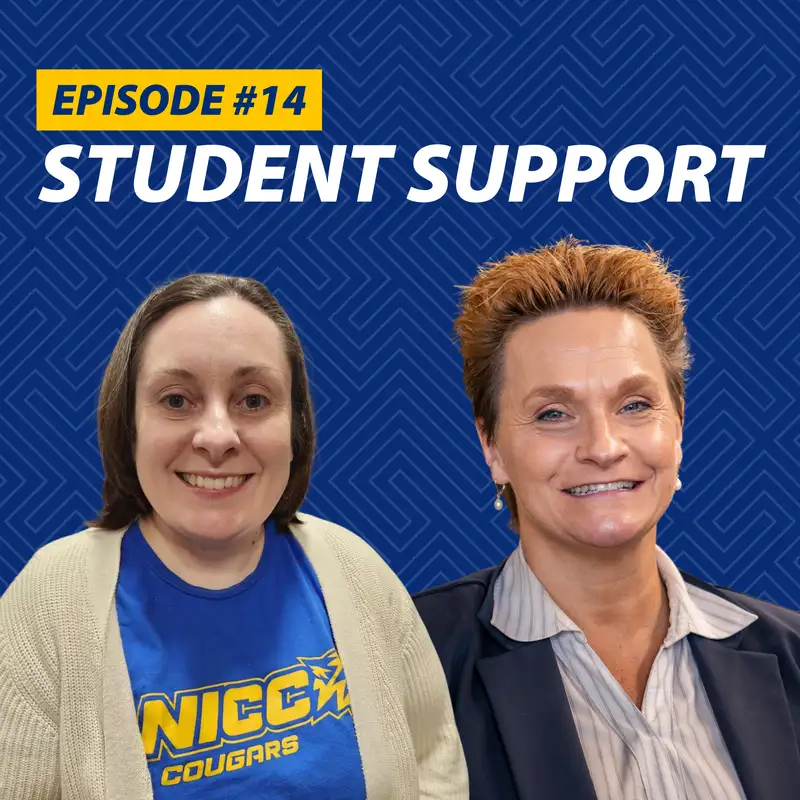
All right, well, welcome everyone to The Catalyst Podcast. Today's episode is all about how students are supported at Nscc and how we can keep them going with different areas of the college, and I'm joined by two guests who see that up close Amy Gaffney, who's our vice president of student services, and Jennifer Wood, our director of accessibility services.
00:00:54:12 - 00:01:19:28
Welcome. Thank you. So let's get right into it. You both really work in roles that can change the entire course of a student's experience at NICC, sometimes with a single conversation. What's the part of your job that a lot of people might not realize is actually pretty rewarding? Amy, we'll start with you. I think it is just those first conversations, right?
00:01:19:28 - 00:01:45:22
When somebody is coming in and maybe hesitantly, even asking about the possibility of, do I start this venture? And honestly, I don't think there's an age for that. So just being able to from the very first impression, welcome that initial question and that initial hello to hear what is their story and what is their goal, and how can we help them get there?
00:01:45:25 - 00:02:06:11
That can be a pretty big decision for somebody to decide to to go to school and take that first step. So that's so important. And Jennifer, your director of accessibility services for a lot of people, they're like, what does that mean exactly? So first can you explain that and then maybe talk a little bit about how your position or your office can really impact a student?
00:02:06:13 - 00:02:34:10
Sure. So accessibility services, what we do is we provide services to students with disabilities. So students that are coming with those, challenges, learning disabilities, physical disabilities, maybe they have some mental health challenges and need some extra supports, to be successful in their classroom. And they all come through my office. And then we can get some accommodations in place to help them in the classroom.
00:02:35:09 - 00:02:59:15
What I find most rewarding about my position, is I am a problem solver and a collaborator by nature. So having students come with these unique challenges and being able to get the different people at the table. Because it's not just about supporting our students, it's about supporting the faculty in the classroom and making sure that they feel comfortable.
00:02:59:15 - 00:03:25:05
And, with how they're teaching and and doing those best practices to engage the students across the ability level. That's a really good point as well. It's it's more of a community internally. And I seek to make sure that that student has what they're need. Jeffrey, I'll stick with you for a minute. We talk a lot about student success at the college, and a lot of times people will say, well, that's kind of a buzz word.
00:03:25:05 - 00:03:53:07
But from NICC’s perspective of how is that different than maybe at a university in the work that you do? Well, one thing about NICC, and with community colleges in general, there is a place for everybody here. So at the larger universities, they have entrance requirements, right? You have to your students have to be at a certain level to get accepted into these larger universities.
00:03:53:10 - 00:04:18:02
And NICC, we have a variety of different programs, and, and students at all different stages in their learning can come here and have a place, and we will help them develop into, what they want to be. So we have those foundational classes, we have those extra supports in place to get students to that same goal, but really meet them where they're at right now.
00:04:18:04 - 00:04:42:19
That's great. Amy, what are your thoughts on the buzzword of student success? I think, what's trending now is it's not just a matter of what does the school put out, but what is a student's personal goal. So what is their true intent? And, you know, for a lot of times at the community college specifically, you really can see how that is very different from more traditional, say, four year schools.
00:04:43:06 - 00:05:09:02
It's not always a two year program. They may need some, you know, upskilling and then, you know, quick and dirty. Some of our short term programs and the right back to it. Or again, they're coming back for their next career. So I think that that is something that it's not just about what we offer, but really understanding, truly what is their intent and how can we help them to get there?
00:05:09:05 - 00:05:29:00
Yeah, it really seems like it's a customized one on one, making sure that each student has exactly what they need at the right time. Do either of you have a story about a student that sticks out to you? Someone who maybe received the support at the right time and and enabled them to complete whatever goal they had? I'll talk about one.
00:05:29:00 - 00:05:51:02
Really? That's, been as recent as this these last few months. So we have, kind of a new process where we have students. We've always the school's always looking and offers the ability for faculty or staff member to raise their hand and say, hey, this student looks like they're not keeping up coursework, or maybe they've been absent.
00:05:51:05 - 00:06:15:05
And this particular student, I just have to say it would look on paper like they just maybe it wasn't a good time in their life to to be at school. So there was a one kind of a one more sling, right? Week, one more outreach with the student, who had a pattern of early alerts, what we call early alerts, and the right conversation at the right time.
00:06:15:05 - 00:06:44:23
And frequent follow up. So over the course of, several weeks, they were basically being coached, receiving some hey, are you getting your work done on time? What are your challenges? And now that student happy to report, got word recently that they have been accepted to a four year school in their engineering program. So what do again, just very recently we were concerned about how can they complete the semester.
00:06:44:25 - 00:07:05:21
So that just comes down to somebody having the right conversation with the right student at the right time to identify what is what are the needs for you, and how can we support you. Love that. Jen. I'm sure you have a ton of stories like that of students that come to you and maybe are very stressed out or just uncertain about where to go next.
00:07:05:21 - 00:07:30:23
And and you're able to help them make those connections so they feel supported. Yeah. I one thing that, that I do is I work with students that are taking college classes in the high schools as well. And so I'm able to meet some students when they're still at their high schools. And I've had a lot of conversations with students that start out with I'm not sure if college is right for me.
00:07:30:24 - 00:07:52:26
I've already always struggled in school, and I'm I'm not sure that I can can go forward with education after high school. And then speaking with me and and going through the accommodations process for some of their concurrent classes, they realize I can't do college coursework, even though it's more challenging. I can still do that with the proper supports.
00:07:53:02 - 00:08:17:29
And I see a lot of our high school students then, you know, come in to NICC and some of our our programs after they've completed high school. And that's really rewarding to that's great. And so, Jennifer, to accessibility services, accessibility can sometimes sound intimidating for students. What misconceptions do students or even faculty have about the services that you can provide?
00:08:18:12 - 00:08:41:29
Well, accessibility services, some of the common misconceptions are that I, that I hear from students, or some of their hesitation with starting the process is they've been told when you get to the real world, you're going to have to do these things on your own. And in reality, in the real world, that, the Ada still exists.
00:08:41:29 - 00:09:06:05
And in the workplace, there are reasonable accommodations that you can get if you have disabilities. Our, college operates on those same rules and regulations, right? So the accommodations that they get here give them access to the learning. It doesn't make that learning any easier. I certainly don't have the power to make the nursing program any easier. It is what it is, right?
00:09:06:21 - 00:09:27:14
But what I can do is I can help students that have those barriers. Maybe their disability is related to reading, and it takes them a lot longer to read, and they need audio books. They're still getting all that learning. They're still getting those skills. But it's giving them giving it to them in a manner in which is accessible to them so they can learn.
00:09:27:14 - 00:09:52:27
They can have that same access. That's fantastic. I'm not sure everybody understands that. We can provide those opportunities for students to learn in a different way. The content is still rigorous. They're just learning in a different way. Amy, another program that you oversee in your department is the Trio program. Can you talk a little bit about what that program is and how that supports students at NICC as well?
00:09:53:00 - 00:10:25:09
Absolutely. NICChas been fortunate to have over 20 years, as grant recipient for the trio, student Support Services program. So, it is a government funded program. It targets students who may be first generation college students who, you know, social, have some other social challenges, maybe learning challenges that, like, Jen mentioned, as well as financial challenges if they're Pell Grant recipients, for example.
00:10:25:12 - 00:11:00:29
And so trio is their own unit, integrated within the rest of the college. But they are able to identify here at NICC, up to 160 students that they help, navigate the college experience with some other support services. A lot of that one on one support. They have a dedicated academic advisor within trio as well as it compliments from our our general advising professional staff, along with consultation on financial aid needs just gives them a a place to be.
00:11:01:19 - 00:11:26:29
Some of that connectedness that we talk about a lot is the trio area really provides that for those students. And so trio helps them navigate through their day to day college experience. But also the ultimate goal is that those students would transfer on to four years. So trio also helps them upskill in areas of social skills, learning skills, navigating the beyond two year school.
00:11:27:07 - 00:11:49:14
By taking them to look at Loyola in Chicago, for example. So there's a lot of life. That trio is able to help those students navigate and just build their confidence and build their own college, you know, advocacy for themselves and helping others. What she what they find a lot is the students are bringing them together.
00:11:49:16 - 00:12:12:18
It is, helping each other as well. So trio is very, very important. And again, we're lucky that we were, approved most recently, this most recent past year. Got approved again for the continuation of the grant. So congratulations, NAACP. Yeah, because I think that's something people don't realize is not all colleges have that extra support system available.
00:12:12:18 - 00:12:36:07
And you mentioned life. And there are very few students anymore. And I feel like it increases every year that can just structure and say, okay, the next two years I'm going to focus on school and not worry about anything else that's happening in my life. So many opportunities, and I seek to make sure that that people have that support that they need.
00:12:36:23 - 00:13:03:27
Jennifer, and for you especially, you probably want to talk to those students before they get to that point where they feel like they just can't handle anymore and need accommodations. Can you talk about how a student comes to accessibility services and asks for the help that they need? Sure. So oftentimes, students are referred, so maybe they've disclosed to a faculty member or their advisor, that they've had learning challenges in the past.
00:13:03:27 - 00:13:34:00
Maybe in their first advising appointment, they talk about having an IEP or 504. So oftentimes it comes as a referral where, somebody will tell me the student mentioned that they may need accommodations and they're connected to me that way. There is an application that students fill out. And that is just a way, in a quick little forum for them to explain how their, disability impacts their, their learning.
00:13:35:01 - 00:13:58:01
And then I meet with the students and they provide that documentation of disability and it's really a conversation. What has helped in the past? What challenges do you have? And then we we go from there. Great. And, Amy, I'm sure your office sees a wide variety of barriers and pressures from students, whether it's financial or emotional.
00:13:58:02 - 00:14:16:07
Can you talk a little bit about the other support systems that are available? Absolutely. The first and foremost, we you know, we tell students just like, hey, we don't expect you to be, the higher ed professional. That is our job. So, it starts with by putting out the app, showing up and saying, I don't even know.
00:14:16:07 - 00:14:37:21
So how does that work? It could be just coming to our front desk to present with a question, that they think was related to their program, when actually it's related to something else. But it starts by having those conversations. So it could be an academic. Question is this class is really tough. Am I in the right program?
00:14:37:21 - 00:15:00:03
Am I in the right major? And how to help have those conversations? Or they're looking ahead and they're panicked because you're thinking, I only see that this class is offered at 2:00 and I have to work at 1:00. And so those are the things that our team is pretty swift. I mean, we have, again, higher education professionals from advising financial aid or mental health, licensed therapists.
00:15:00:14 - 00:15:22:20
Just a great web of support. So coming in, it really starts with you don't even know what the question is, but that's our job to help you that, you know, get that out there it out. Where are those, places we can support? So, yeah, you just start by asking the question. And our team, if we don't know, we're going to know where to where to make the handoff.
00:15:22:20 - 00:15:48:14
And I think that's what's also great about the size of NICC is that, you know, we can walk down that hall or pick up that phone. It just ask and reach out to because reach out to the other areas. So it's really, really important that our students understand that. And parents understand we have a lot of conversations to to help parents understand that we value their support of their student.
00:15:48:14 - 00:16:10:02
But it is a time there are some some life skills. And that starts by helping them help their student have a self, you know, advocate. So that's a big one of our lessons too, is sometimes we're helping the parents understand how to support their students as well. Yeah. And when you were talking, you were talking a student, whether it's a BCS student or a credit student.
00:16:10:02 - 00:16:44:05
And, Jennifer, I think that for your office, there are a lot of people that might think your office is only for a credit student, somebody coming in for a degree. But that's not necessarily true, is it? No. Now, I often joke, I live in in all, all the worlds. Because we do, we provide sports to all students, whether they're here for, a career pathway certificate, whether they're a driver's ed student, whether they're here just to do some testing for, another institution.
00:16:44:18 - 00:17:15:15
And then, of course, in our credit programs, any students, across the board can, can access our services. Yeah. Not necessarily just getting services if you're on the campus, if I'm a student, going to a class and walk on your office can still help provide some support systems. Correct? Yes, absolutely. So students that, that qualify for accommodations, they can get their accommodations no matter where, where their, their classes are located.
00:17:15:15 - 00:17:35:28
And we do routinely have with our video conference classes, there are students that are taking classes at all of the remote locations. And sometimes it does take a little bit more coordination, to put those pieces in place and collaboration. But that's what we do. We we get the people to the table that that need to be at the table to support each student.
00:17:36:05 - 00:18:00:22
And we have those conversations. And everybody is so great with working with all these students and just making it happen. That's great. Jennifer, how many approximately how many students do we provide accessibility service support to every year? It is a little over 200 with our concurrent class, with our with our concurrent students in high school. Yeah. So quite quite a few students access it.
00:18:00:22 - 00:18:29:26
And it's just another way that we want to make sure any student that feels like they might need additional support shouldn't be afraid to ask. We want them to ask for that. Absolutely. Amy, your office also has admissions and recruiting. What are some messages that those folks bring out on the road as they talk about NICC and kind of all this pieces that we're talking about here in the support of NICC, that was coming to NICC.
00:18:29:29 - 00:18:53:02
Yeah. I think that one of our key messages for any students in the college exploration process is it starts with, what are you interested in? You know, tell us a little bit about what you know, where you spark. You know, not everybody loves going to history class, but then you've got that person who has the vision. Or again, they maybe they do some welding at home.
00:18:53:13 - 00:19:18:17
You know, in the, in the family business, family farm or what have you. So let's it starts there and then we, as Jennifer referenced earlier, is like, you know, at in our school, we have a lot of ways for to find that path for that, for that individual student. But the next most important thing a student can do if they're exploring their college options get to campus, come and see the facilities.
00:19:19:05 - 00:19:55:23
It is the statistics tell you that a student is twice as likely to enroll once they come to campus, because it's that it's that feeling. It's that, you know, how do you how do you nail it? But it's really, really important to take that time, come to one of the many opportunities, whether it be a one on one conversation, whether it be a zoom call initially, but getting a student to come and experience the campus where they can get their specific questions answered by the subject matter experts, whether that be the admission rep, the faculty person who's the subject matter expert, or our advising team.
00:19:55:23 - 00:20:24:17
Financial aid, career services is is also a really key conversation for students. So that's really what it's about. It's like, hey, come see what we have. Let us show you. Our beautiful facilities are our expert faculty and professional higher education professionals. Let us do that work for you. But come here and let us help you. Yeah. And we have beautiful campuses and buildings and I just maybe I'm biased, but come see us.
00:20:24:17 - 00:20:48:23
We'd love to host. Absolutely. Yeah. A great. Yeah. Well, the next segment I have is our Affective fiction segment, which is kind of fun. And so both of you guys can jump in with your thoughts, fact or fiction, unless it's fiction. I want you to clear it up for us a little bit if you can. Okay. So the first one is only full time students can access any student services for free.
00:20:48:23 - 00:21:15:09
Is that fact or fiction? Fiction? Definitely. Yeah. And again, the student services come on down. Again, you don't even know all the things. I think one of the, one of the significant numbers this fall, we had the first night of classes. We had an outdoor movie night. Over 100 students showed up, and we didn't just say, come sit on the lawn.
00:21:15:09 - 00:21:35:02
We're like, hey, have a candy bar, have some popcorn. So that's the fun part. But again, we have a lot of other things. We have a beautiful facilities, as you mentioned, you know. Are you a gamer? Not only do we have a e-sports team, but we have a beautiful gaming, arena, both, Kalmar and Piazza. So come on and experience that.
00:21:35:04 - 00:22:10:08
Play some pool, get to know other students. So yeah. Really fiction fiction, fiction. Lots of opportunities for you. All right. So what about you can change your major once at Nick also fiction. So the beautiful thing that we have in the, in the student self-service information system, which every student's going to live in there, there's a lot of information at their fingertips when they're twirling at 2 a.m. on a Saturday night, they can log in and a great tool that they have is okay.
00:22:10:08 - 00:22:34:18
Right now I'm listed as an accounting program. But, I heard someone speak the other day about, CNC. You know what? If I change my program? What if I change my program? They have the ability in self-service to see what that would do to their class. You know, requirements. What would that look like if I wanted to now become an AA, major?
00:22:34:24 - 00:22:54:21
And let's let's see what that would do. So we encourage, exploration. Those are the conversations career services getting out there, taking those classes. Any electives. Try it on for size. Yeah. Bottom line you don't know if you don't ask. So find out and see what you can do. All right Jennifer I have a feeling this one might be for you.
00:22:54:21 - 00:23:20:08
So the accessibility or learning center is only for failing students. Is that fact or fiction? Fiction? No. We're hoping to get students as early in the process as possible. Our learning center. I really think every student should make an appointment for the learning center within the first couple weeks of being a student, if for nothing else, to understand how they learn.
00:23:21:16 - 00:23:43:08
The learning curve, when you're coming back to college or coming out of high school is huge in knowing how to study, how to how do I retain information? What are my study habits? Those kind of things. Absolutely. That's great. Here's another one. Fact or fiction asking for accommodations means professors are going to treat you differently.
00:23:43:08 - 00:24:22:00
Fact or fiction? Fiction, fiction, fiction. The intention of accessibility services is to give everybody an even playing field. And ideally, and one thing that students, don't realize is a lot of times a lot of our faculty are building things into their courses for all students. So things like recorded lectures can be accommodations. But many of our faculty are doing all of these things because it's best practice for all students to just have, you know what we call universal design access for everybody.
00:24:22:03 - 00:24:45:09
Yeah. Faculty want to see every student succeed. Absolutely. What about we haven't talked about it yet. So maybe in the answer to this you can explain what this is a little bit. But the Student Crisis Fund has to be paid back. It's a loan that's section Big Ten. We have a. So you're right we didn't really talk about you know, making college affordable.
00:24:45:11 - 00:25:14:02
So between our financial aid team who again everything starts with a free application for federal student aid institutional grants. There are three different points throughout the year where a student can apply to any CCS, scholarship program. But when we talk about price, something's come up that we just didn't know was going to happen. But it's, you know, interfering with a student's ability to be the best student they can be, which is really what we're doing setting the stage.
00:25:14:04 - 00:25:38:27
And that could be anything from, hey, my utility bill went through the roof because I didn't know I had a leaky faucet or my tire went flat on the way to work, and now I need $100 and I don't have that. So that is we do have, the crisis fund is is one example of where a student can say, reach out and just say, I need some help, and this is what it looks like.
00:25:38:27 - 00:26:03:22
And those are applications that are turned around very quickly, that the group that manages that is very attuned. I've had people who answered and found themselves homeless because of the fire, so we needed to help them find a, you know, hotel for a couple of nights. So, yeah, you can't define crisis. But what we can do is give them a means to at least, ask for help.
00:26:03:24 - 00:26:28:10
So that's what that's all about. And it is not something that needs to be repaid. And it's one of those things where, just last week, the college held a fundraiser across its different campuses to raise money for this particular fund. And it's always so heartwarming because everybody at the college wants to see students succeed. We don't want something like a flat tire to hold somebody back.
00:26:28:13 - 00:26:48:22
That's great. How about this next one? You must have a high school diagnosis for accommodations. Fact or fiction? Fiction. So, disabilities can happen at any point in your life. So you may not have had accommodations in high school. You may not have had an IEP or a 5 or 4 in high school. But life happens, right?
00:26:48:28 - 00:27:17:10
Health challenges happen. Mental health challenges happen. Accidents happen. Some of our disabilities, they might be short term. So somebody has a concussion or they were in a car accident and they need something short term. They need some accommodations to help them access, things for six months or whatever. Or maybe it's a new challenge. We certainly can use IEPs and five offers, and that information from high school that still applies.
00:27:17:12 - 00:27:39:02
But it doesn't doesn't necessarily mean you need to have a diagnosis that dates back to high school. That is a great thing that I don't think a lot of people realize is that it might be a short term thing that that somebody is going through, and they need accommodations. So thank you for clarifying that. All right. Next one, students only visit the vice president of student services, Amy Gaffney, for when they're in trouble.
00:27:39:02 - 00:28:01:11
Is that factor section oh, total section. Total fiction, as a matter of fact. You know, I had had the fortune, of late due to some other conflicts that I've. I've given a student a tour. I've met with them when they had some, interest in. Gee, I'm not sure what programs or this. Just have some general questions.
00:28:02:07 - 00:28:25:03
The incident last week was a 30 year old who came to campus for testing and thought is, while I'm here, what else can I get done today? And so I had the good fortune to walk and talk. And, not only did we walk and talk, we completed two, not one, but two passes. And, you know, talked about his income, you know, expected income change.
00:28:25:03 - 00:28:47:00
So it was a great opportunity. And I look forward to hearing from students about their experiences, because, you know, the one thing that happens and and Vincent Tinto is a famous researcher that talks about, you know, what makes students stay and what influences they're leaving. And it comes down to connection. And that's not just what's going on in the classroom.
00:28:47:00 - 00:29:07:17
We know that that's a major factor, but it is that social interaction as well. And it's not a decision. It's usually something that's been culminating over time. So the more we can hear and talk to our students and engage with them directly and understand, what it is they're facing, the better we can support them. Great. All right.
00:29:07:17 - 00:29:19:07
Last one factor fiction Accessibility Services has a secret stash of snacks that fact and fiction. Well, that may be true.
00:29:19:09 - 00:29:42:20
Although I don't I don't know that it's so secret. The worst kept secret. The worst kept secret ever. No. We do. We have treats. And you know, we have our testers and stuff coming in to the testing center. And, you know, a piece of chocolate really does help ease my anxiety when you're going into testing. Not a true fact.
00:29:42:20 - 00:29:57:12
Hasn't spoken on this podcast. That's why it's so true. All right, so before we wrap up, if each of you could give a piece of advice to a student who might be struggling right now, what advice would you give them?
00:29:57:15 - 00:30:21:23
Come see us. Just come in, come in, come in. Call, email and say, I don't know what I need, but I know I need, I need some help. Because I just say we are the higher education education professionals. It is our job to know how you know all the things available. So raise the hand. I would say you're not alone.
00:30:21:26 - 00:30:43:05
Everybody has challenges. Everybody has hurdles, everybody has barriers. And we are here to help you. We want to see you succeed. And we want you to know you have support. And you don't have to face these things alone. That's great. This is the perfect way to end. So I want to thank both of you for your time today and the work that you do every day to help support students at NICC.
00:30:43:14 - 00:31:08:24
For those of you that are listening for more information on resources, check out nicc.edu/studentresources. Or you can email, admissions@nicc.edu. We'll make sure you get to the correct place. So thank you ladies both again for your help and, conversation this last half hour. Thanks for having me. And thanks to everybody else for listening to the Catalyst podcast.
00:31:08:24 - 00:31:14:25
Don't forget to subscribe whereever you get your podcasts and catch our next episode.
00:31:14:25 - 00:31:30:00
Thanks for joining us on this episode of The Catalyst. If you enjoyed the conversation, make sure to follow our subscribe on your favorite podcast platform so you never miss an episode! Want to learn more about NICC and the many ways we support our students, partners, and community?
00:31:30:03 - 00:31:46:18
Visit nicc.edu for more resources and upcoming opportunities. This podcast is produced by Northeast Iowa Community College and hosted by me, Amy Lasack, with executive producer Tessa Hill, producer Travis Hunt, and graphic designer Ashley Konzen.