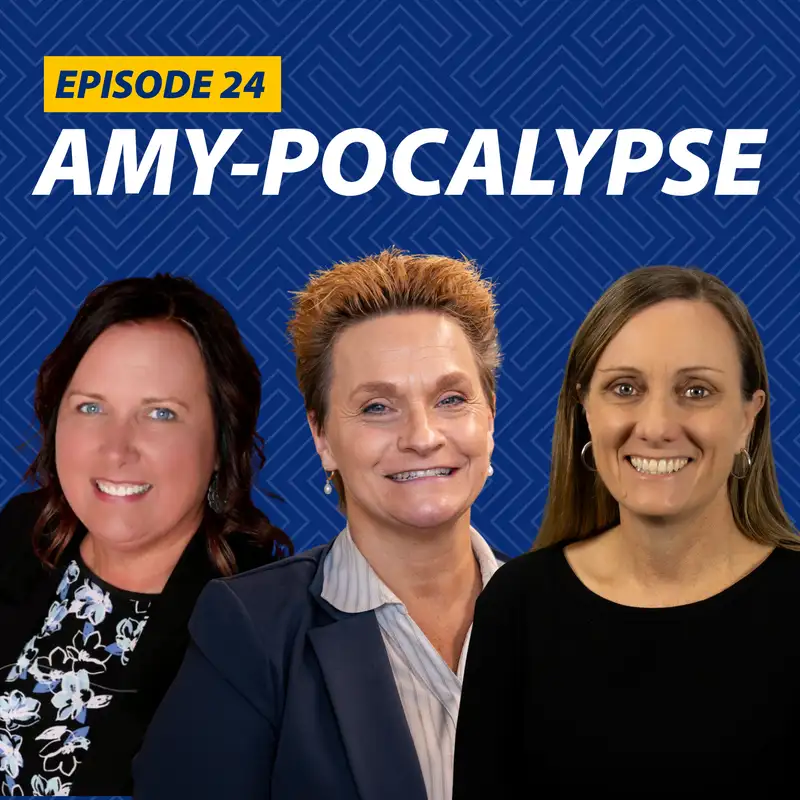
Welcome to The Catalyst, an exciting and insightful podcast produced by Northeast Iowa Community College. I'm your host, Lasack. Together, we'll explore the people, programs, and partnerships that make Northeast Iowa Community College unique. From student success stories to behind the scenes info about athletics, innovation and industry collaboration, each episode dives deeper into your community's college. Get ready for an inside look at the impact of community driven education at NICC.
Amy Lasack:All right, and welcome to The Catalyst. I'm Amy Lasack, and we are so excited to have you here today. Today's episode is going to be a little different and a lot more fun. So if you work at NICC, you already know this, we have a lot of Amy's here. And so we thought, why not?
Amy Lasack:Let's lean into that fact. This episode is all about the NICC Amy's, who they are, what they do, and maybe clearing up a little confusion along the way. So I hope you laugh during this podcast, you see a little bit of the personalities and at least one, wait, which Amy is that moment as we go. So I'm gonna introduce our folks and we're gonna have them talk a little bit about what they do at NICC and then we'll jump right in. So first we've got Amy Gaffney, Vice President of Student Services.
Amy Lasack:We also have Amy Green, Director of Sales and Training in Business and Community Solutions and Amy Rausch, Respiratory Care Program Director. Welcome, Amy.
Amy Green:Thank you, Amy. So,
Amy Lasack:Amy. Let's just jump in and learn a little bit about each of your roles first. So Amy Gaffney, can you talk a little bit about your role at NICC?
Amy Gaffney:You bet. So vice president of student services, meaning there is a division of student services and there always has been student services, but not necessarily always organized in this fashion. So in today's world, there's about 11 different departments within the realm or the division of student services. So that includes admissions, of course, advising and registration, athletics, career services, college and career connection coaches, financial aid counseling, that's mental health or brain health counseling, registrar student life, trio student support services, and a community standards coordinator. So those are just several of the teams that work together to support our students in and outside of the classroom.
Amy Lasack:Yeah, so a lot of really great things to help our students be successful at NICC. That's great. Amy Green, so you work with business industry. Talk to us a little bit about what that means.
Amy Green:Sure. Hello. I get the pleasure of working with our business community in business and community solutions. So I'm the director of contract training, which is sales and training. We get to work with our business community throughout Northeast Iowa to help them with their workforce challenges.
Amy Green:So anything workforce related from getting businesses connected to our students, getting them connected to training opportunities either through our short term training certificate programs, credit programs. But our specialty is our customized contracted training where we bring industry experts into our businesses to help upscale, reskill, train their existing workforce. So we have a team throughout Northeast Iowa, a team of four that I lead out there working with our businesses.
Amy Lasack:Great. Thank you, Amy. Amy Rausch, why don't you give us an overview of the work that you do at NICC?
Amy Rausch:So here at NICC, I'm the program director for the respiratory care program. Our program here at NICC, it is based on the Piazza campus, and it's a two year associate of applied science degree. Our students in our program learn anything from, you know, assessing the respiratory and heart systems all the way up to doing emergency care and intensive care units where we manage ventilator care. We teach our students everywhere from, you know, treating premature neonates all the way up to elderly care. Our students spend, you know, a lot of time in different clinical rotations working on critical care as well as, you know, they go into home care and sleep labs, we try to get them into as much respiratory care areas as possible.
Amy Lasack:Yeah, such important work. You're putting a lot of fantastic people into our hospitals and medical organizations as well. Thank you for the work you do, Amy. So let's start with the obvious. How often do you guys get emails meant for other Amy's?
Amy Green:I would say Amy Gaffney and I probably get the most just because our email is set up with our last name, first name initial. So when they start with the g, they have to make sure that they select Gaffney and not Green. I
Amy Gaffney:like to refer to Amy Green as Amy Ogee here at NICC. So before coming to NICC, I often just would sign my emails, refer to myself as Amy G. And then I get here and there's already an Amy G. So Amy Green Z, Amy OG. But yes, every once in a while we get some communications and, you know, is this really who you wanted to talk to?
Amy Lasack:Amy, has that happened to you? Amy Rausch? See, I already did it. I
Amy Rausch:think being on the faculty side, and there's not as many Amy's on the faculty side, I don't get too much confusion. I don't think I've gotten anybody's email that I wasn't supposed to that I can recall.
Amy Lasack:So are you all like me that you automatically perk up anytime you're in a meeting and somebody says Amy and you turn and you're like, what's going on?
Amy Gaffney:I was going to say that, that I think it is funny that Amy and I are in meetings, Amy Lasack and I are often in meetings together and you kind of grow to that you both perk up and then the next words out of their mouth like, okay, it's not me. Yeah. Yeah. But you're still listening, but it's like, okay, try not to commit to something that really wasn't directed to me. I think that's been the biggest training and restraint is not volunteering where you're really not the audience they're talking to.
Amy Gaffney:So
Amy Rausch:Like, I'll hear my name, then they'll ask a question. And I'm like, I'm not prepared to answer that. And then I realize it's not for me. So
Amy Lasack:Yeah. Yeah.
Amy Green:Amy Lasack, I would say you and I are unique because we work on the same team with the same individuals. So we have to really be cognizant of Amy L, Amy G. So there's a lot of Amy questions of like me or the other Amy.
Amy Lasack:Which one? Has it always been like that for you growing up? Did you always have a lot of Amy in school or anything like that?
Amy Rausch:I did. I had two of my best friends were named Amy. One was spelled the same way as mine and the other one was A I M E E.
Amy Lasack:Okay. Amy Gaffney, I saw you shaking your head. You didn't have a lot of Amy's growing up?
Amy Gaffney:Not at all. No, honestly. And it's funny too, because we also didn't note that we all spell it the same way. No, it was very unusual and it which is funny because then you reach this stage of life and like we're everywhere, So it wasn't until my former employer that there were probably a couple three that were often in meetings. But before that, it's really not been a very common thing for me.
Amy Gaffney:Interesting. Amy Green, what
Amy Lasack:about you?
Amy Green:For me, it's different. Growing up, one of my best friends who had the same last name as I, her sister was Amy. So we had two Amy's in the community. And then moving to Dubuque County, living in Cascade, I have a sister-in-law that's Amy Green, and there's another Amy Green in town. So I've never really got to be Amy Green.
Amy Green:I'm associated with my husband's name oftentimes in the community that I live in.
Amy Lasack:Oh my gosh. Yeah. So you're Amy Green who's married too. Yeah. Yeah.
Amy Lasack:Add an additional
Amy Green:Even my mother-in-law has to differentiate, between me and my sister-in-law, by our middle names. So I'm Amy M. She's Amy T. So
Amy Lasack:Oh, hilarious. Yeah. I I think growing up, I always had the the last initial tagged on to my name, but I that's interesting that you have to do the middle name because there's too many Amy Greens.
Amy Green:Yeah. Yeah. We confuse the mail office, post office regularly.
Amy Lasack:Oh, I bet. That's hilarious. So if how do you distinguish yourself from other Amy's? Are there certain things, certain qualities or certain things that you see?
Amy Gaffney:The hair. The hair. That has been my trademark. Even right out of high school, I actually took a second job. I was working in two stores in the mall.
Amy Gaffney:And when I started working at the new store, somebody would go up to the counter and they're like, oh, did anybody help me today? And the reference was, the one with the hair. And so the manager would say, I wasn't aware we had anybody without hair. But we knew. So that that truly has been probably the the mark for me.
Amy Lasack:That's funny. When I know Amy Gaffney, there's a funny story because we started we both started about a month from each other. Yes, yes, I think you know the story I'm talking about. Do you want to share that one?
Amy Gaffney:I do. Yeah. And actually, I'll slip another one in there. So I started about six weeks before Amy. So I was at our first board meeting.
Amy Gaffney:It was at the Dairy Center and I'd never been to the board meeting, you know, my first just getting to meet people. And during that meeting, there was a reference to the 260Es, and the chair looked over to me as if I had something to say about 260Es. I just nod along in agreement, but I'm like, I'm not gonna make that distinction in a public meeting. But it was, yeah, that following, I think that following December or something. Anyway, an encounter with Doctor.
Amy Gaffney:Wee. I'd never met Doctor. Wee before. And I met him. It was actually at the Des Moines event in February that year.
Amy Gaffney:And one of our board members says, you've never met Doctor. Wei. You have to meet Doctor. Wei. So I go over and have the niceties and exchange and literally just a very brief conversation, heard a lot about you, all that business.
Amy Gaffney:And again, Doctor. We is so graceful, just gracious. And then I saw him later in the day just more of a passing remark. That was it. Amy L bumps into him, you bump into him like several weeks later and you meet him at another event.
Amy Gaffney:How did that go when you met Doctor. We?
Amy Lasack:Oh, was I mean, it was great. You know, Doctor. Wee is a former president at NICC and he was interim at Eastern Iowa when I had talked to him. And great person. I've never heard anything bad about Doctor.
Amy Lasack:Wee, but we had a nice conversation. And I can't remember if he said it to me or said it to you later.
Amy Gaffney:He said it he said to you as you report it, you're like, yes. He says, oh, the quiet Amy.
Amy Lasack:Yes. And then I
Amy Gaffney:And then I ran into him in June. There was an event in Decorah, and I was just manning a table. He came over to say hello because that's who he is. And again, I said, oh, so nice to see you. And he goes, the not quiet Amy.
Amy Gaffney:And so I he must have assumed that we had connected that he had deigned you, the quiet Amy, and me not so much, but what a delight. Yeah. Truly delightful. And probably, admittedly, I probably live up to that. Amy
Amy Lasack:Rausch, I'm curious because you work with kind of the next generation of names coming out into the workforce. Do you see a very common name coming through with the ages of students that you're working with?
Amy Rausch:I do. Not a lot of Amy's so far, but a lot of Olivias. I have had quite a few Olivias in the program. In fact, I have two right now in the program that seems to be probably one of the more common names coming through that I've noticed.
Amy Lasack:Interesting. I know when I had my two kids, I wanted to make sure they didn't have a name everybody else had. Right? When you were naming your children, what you were named come into effect at all?
Amy Rausch:It For me, did. I have three children and my oldest has a very common name. Her name is Megan, which is common. And then my two younger ones are a little bit more unique. So we named our second daughter Kennedy, which is kind of ironic that I see a lot of Kennedys now, her age, she's 21.
Amy Rausch:And then my third one is a boy and we named him Rylan, R Y L A N, which is again is uncommon, but funny story, Megan just got married and guess what her husband's name is?
Amy Lasack:Oh no. Hilarious. Go figure. Amy Green, what about you? I know you have three boys.
Amy Green:Yeah, three boys. Not, I mean, uncommon names, but names that aren't super familiar either. So my oldest is Riley, which can go boy or girl. So not a lot of boy Riley's. I've met more probably girl Riley's, which he reminds me of a lot.
Amy Green:And then my middle son, Spencer. I think Spencer's kind of an older name, but has kind of made a resurrection back with some of the younger generation. And then our youngest, we let his brother's name him. So Zach, which is a very common name. So although I we the joke at our house, I let my husband it's Zachary.
Amy Green:And so I let him decide the spelling, and he went e r y, which is against the norm. And so Zach always reminds us that he can't find a pencil or a license plate or anything with his name on it because we misspelled it. It should have been a r y.
Amy Gaffney:That's funny.
Amy Lasack:You are very brave to let your two older kids name your youngest.
Amy Green:It was was gonna be Jack or Zach or, you know, they they went kinda back and forth. But
Amy Lasack:lives. And then my youngest, we had the hardest time. We knew if he was going to be a girl, what we wanted to name him and could not find a boy's name for the life of us. So, but my sister was pregnant at the same time, found out she was going to have a girl, and so we stole her name for a boy, which was Parker. We like that name.
Amy Lasack:But, yeah, again, I wanted to find something a little bit different. Mhmm. But speaking of which, you know, growing up, we probably were able to find our names on anything. Yeah. And and now I'm looking at some of these displays and Amy is hard to find on things.
Amy Green:Mhmm. Yeah. You
Amy Gaffney:don't hear it coming up in today, you know, the youngsters of today.
Amy Lasack:Yeah. It's definitely declined quite a bit. So, what are you know, each of you have been at NICC for a different amount of time. What are some of the things that you really enjoy about working at NICC? And we'll go backwards for the amount of time you've been here.
Amy Lasack:So Amy Gaffney, you've been here about two and a half years?
Amy Gaffney:Yeah, just about two and half years, October '23. Think just the frankly, it sounds simple, but truly the people who are just so motivated to serve students and bring them into the world right before they take that next step, whatever that next step is for them is, you know, people wrap around that student and say, how can we help you? So that is fun for me to see that and to think about all the possibilities. I get really excited about the possibilities of how NICC can continue its work in supporting students and then our own teams getting excited about how they can continue their work to support students.
Amy Lasack:That's fantastic. And Amy Green, how long have you been at NICC?
Amy Green:I've been here ten years now already, which is crazy. It doesn't seem like it's been that long. The thing that surprised me the most, I'm gonna say coming to NICC, I always thought of it as a two year college. So coming into business and community solutions and seeing a different side of the college was fascinating to me. I had no idea how much we embody the word community.
Amy Green:So just being embedded in the communities that we serve, a lot of my team is serving on committees and boards and the partnerships that we have throughout our district are just incredible. So that was one thing I just didn't have that perception of NICC prior to coming. I just thought of it as an educational institution and not the breadth of the community involvement that we have.
Amy Lasack:Yeah, we do hear a lot. We didn't know NICC did that. Mhmm. There's a lot of lot of different areas that we touch on. Amy Rausch, you were just talking to us before the podcast.
Amy Lasack:Twenty five years at NICC.
Amy Rausch:Twenty five years. I started in August of, 2001, and so I've been here for twenty five years. And I think the thing that I noticed the most is students aren't a number when they come through our door. All the way from advising and financial aid and admissions, all the way through until they graduate with faculty working with them. I think they really truly think that we care about their academics professionally, and I think they really do know that we care about their success while they're here at the college.
Amy Rausch:Another thing that I can really say is NICC has always been supportive of our program needs. So anything that we need to help our students succeed and to help prepare them to enter the workforce as a respiratory therapist, we have been given to use. We actually just recently acquired a simulator for our lab, which has been a huge improvement for our lab. It just gives the students a safe environment to practice their skills while they're here at the college.
Amy Lasack:Very cool. And how many students do you have in respiratory care right now?
Amy Rausch:We accept 16 each fall semester. Right now total, I have 14.
Amy Gaffney:That's great. So yeah.
Amy Lasack:Alright. Well, if you've heard the podcast before, you know we like to do a fact or fiction, just kinda some fun factual things or some fictional things. And I'm gonna read a couple, and I'm gonna have you guys shout out whether you think it's fact or fiction. First few, I have one for each of you, and then the last couple, we'll just have you all shout out what you think. So first one, Amy Gaffney.
Amy Lasack:Student services only handles administrative tasks like transcripts, ID cards, and graduation applications.
Amy Gaffney:Wrong answer. That is fiction. Yep, big time. We put the student in student services. So it's very people centered while we help them with some other things, some of
Amy Rausch:the
Amy Gaffney:transactional work and bureaucracy, it is really about the supporting of the individual person, whether it be live or via Zoom, helping that student navigate the path throughout their time here and even beyond.
Amy Lasack:Yeah. Absolutely. Some of the most supportive people you'll find are in the student services department. They're passionate about their work. Yeah.
Amy Lasack:Yeah. Really wanting the students to succeed. So that's great. Amy Green, the business and community solutions team can create a 100% customized training plan for a local business through collaboration and innovation. Is that fact or fiction?
Amy Green:That is fact. 100% fact. And actually, what we pride ourselves on and differentiate ourselves from our competitors is the fact that we can customize all of the training that we do. And we do that in conjunction with the large pool of instructors, subject matter experts that we employ to do that training. Our business there's no cookie cutter training when it comes to NICC training.
Amy Lasack:Absolutely. I know one of the things you really pride your team on is the flexibility that you can open for businesses. Alright. Amy Rausch, in the last three years, respiratory care graduates have achieved a 95% state board exam pass rate and a ninety five percent job placement rate. Is that fact or fiction?
Amy Lasack:That's fact. Wow, ninety five percent. That is fantastic.
Amy Rausch:Yeah, we do a lot of practice exams throughout the course of the program, as well as some discussions during lecture about some of the exam questions and what they're to expect on the exam. As far as job placement, there is a nationwide shortage of respiratory therapists right now, a pretty big nationwide shortage. So there is jobs, our students get jobs very easily. In fact, our graduating students that will graduate in May all have full time jobs lined up already before they graduate. So the jobs are out there and the profession is growing really fast.
Amy Lasack:What are some of the places that our recent respiratory students have been placed at?
Amy Rausch:Of course, the two hospitals here in Dubuque, MercyOne and UnityPoint Findlay Hospital. They go to University of Iowa, they've been employed there, University of Wisconsin, Cedar Rapids hospitals, Waterloo. Some of them go up north, you know, like to the Mayo Clinic area, Rochester, Minnesota area, but a lot of them do stay in Iowa. Genesis and Davenport, which was just acquired by MercyOne, our students go there. MercyOne in Clinton, Trinity Rock Island, which is in Illinois, so all over.
Amy Lasack:And they
Amy Rausch:can get jobs in home care. I have one student going into home care next year. So diagnostics is another area they go into. So there's just a lot of different areas that they could specialize in if they choose to.
Amy Lasack:Yeah, much opportunity there. That's fantastic. I love to hear that. Alright. So this one, any of you can to shout out fact or fiction.
Amy Lasack:At least one of the Amy's on this call has accidentally attended or been invited to a meeting meant for a different Amy. Fact or fiction?
Amy Green:Fact.
Amy Lasack:Yeah. That probably happens a few times a year at least. What about this next one? If a new Amy is hired, there is a brief moment of collective collective panic.
Amy Green:Probably from our IT team or setting up a new Amy account. Yeah.
Amy Gaffney:I will say that I think that's the thing is we lean into, like, each one of us. Like, I have no problem looking over the table at Amy L knowing like, that's you. Like, I think we respect each other's area of what we know how to best handle it. That's the right Amy for the job.
Amy Lasack:Yeah, I think one of the things that's really interesting at NICC is Amy isn't the only name where we have a core group of the same named individuals. Like there's several Aaron's, there's several Greg's, and you always kind of Yeah, have to you always kind of have to be like this Christie or this Erin to make sure everybody understands. So we're almost kind of used to it at that
Amy Gaffney:point. Yeah. All
Amy Lasack:right. Last one. Even though we already have a lot of Amy's, we're still gonna keep hiring Amy's anyway. Is that fact or fiction? Fact.
Amy Lasack:Yes. Shout it from the rooftops. We've got a lot of great Amy's. We could use some more, right? Well, great.
Amy Lasack:Well, this has been way too fun. So thank you Amy's, Amy Rausch, Amy Green, Amy Gaffney for taking the time to talk. It was just a fun episode for us to connect. I wanna thank you all for being great sports and proving that even if the name is the same, our personalities are different, our roles are different. And to our listeners, if you ever say I talked to Amy at NICC, at least include one identifying detail.
Amy Lasack:Thank you all very much. And thanks for everybody for listening. We'll catch you next time on The Catalyst. Thanks for joining us on this episode of The Catalyst. If you enjoyed the conversation, make sure to follow or subscribe on your favorite podcast platform so you never miss an episode.
Amy Lasack:Want to learn more about NICC and the many ways we support our students, partners, and community? Visit nicc.edu for more resources and upcoming opportunities. This podcast is produced by Northeast Iowa Community College and hosted by me, Amy Lasack, with executive producer Tessa Hill, producer Travis Hunt, and graphic designer Ashley Konzen.